How Operational Scalability Works in Social Care
It's 9 a.m. and your queue already doesn't match your staffing plan. A billing complaint sits in Instagram replies, outage reports are stacking up in X mentions, and a Discord thread that started as a joke now contains a real safety report. Nothing here is unusual. That's the problem. Operational scalability in social care isn't about answering faster at any cost. It's about deciding, under pressure, what AI may close, what it should draft for review, and what a human must own immediately.
Table of Contents
- When Inbound Social Work Outruns the Queue
- What Operational Scalability Actually Changes
- Metrics Leaders Should Watch Beyond Speed
- How Routing Turns Noise Into Owned Work
- Platform Limits That Break Naive Automation
- Scaling Through Outages Spam and Crises
- Choosing an Operating Layer and Next Steps
When Inbound Social Work Outruns the Queue
A customer posts a billing complaint on Instagram, reports an outage on X, and sends a private message on WhatsApp. Each item reaches a different tab, and the team may see them at different times. The problem is not a lack of effort. It is that social care work arrives across channels faster than people can reliably notice, sort, and own it.
Sprout Social's research on social customer service expectations describes rising customer expectations for brands on social channels. The operational point is clear without relying on a precise daily count: when more messages compete for attention, a team needs a dependable way to identify and route the ones that need action. A queue is like a control tower. Its job is not to make every response automatic, but to help urgent work reach the right owner before the clock runs out.
Three different jobs hiding in one queue
Customers experience a public post and a private message as parts of the same conversation, even if different teams handle them. Social care therefore has three related tasks: notice the message, acknowledge it in the appropriate place, and resolve it with the right context.
A public reply such as, “We're looking into this, please check your DMs,” can confirm that the brand has seen a complaint. It cannot resolve a double charge. Sending a customer straight to a private message without acknowledging the public post may make the brand appear evasive. And if the public thread is closed before the customer replies privately, the case can lose an owner.
Coverage rule: Measure whether the right item received the right first action, not whether someone replied before the SLA clock ran out.
Routing accuracy helps distinguish work that looks similar in the inbox but needs different judgment. A billing complaint in comments may need account context and finance or support ownership. A cluster of outage reports calls for pattern detection and escalation, rather than a series of disconnected replies. A feature request in a direct message may belong with product, once the team has separated it from routine how-to questions.
AI can help classify messages, identify repeated outage reports, and draft a public acknowledgement for review. It should not independently decide how to handle a suspected account compromise, safety report, or sensitive billing dispute. Those cases require a human to assess context, take responsibility, and make the decision.
Noise makes real risk harder to see
Spam and scam posts sit beside genuine fraud warnings. A screenshot of a meme may include a complaint that a keyword rule misses. Multilingual slang can blur the difference between a threat and a joke. If agents must sort every message by hand, urgent work competes with easy replies for the same attention.
- Public mentions: Need visible acknowledgement and attention to reputational risk.
- Comments: Can include repeat questions, sarcasm, and complaints directed at other customers.
- Direct messages: Often contain account details, receipts, screenshots, or concerns customers want to keep private.
- Community threads: May shift from peer support to misinformation or conflict without directly tagging the brand.
Treating these sources as one undifferentiated inbox can make activity look healthier than coverage really is. Reply counts can rise while outage reports wait, because the team cleared simple comments first. Average response time can improve while a safety report sits unseen. Throughput matters only when routing keeps high-risk work visible and assigns it to someone accountable.
Teams working across voice and chat may modernize contact center operations by connecting intake, routing, and ownership instead of relying on whoever happens to spot a message. Social care needs the same discipline, with extra care for public visibility. The goal is to shorten the distance between seeing a signal and putting it in the right human's hands.
What Operational Scalability Actually Changes
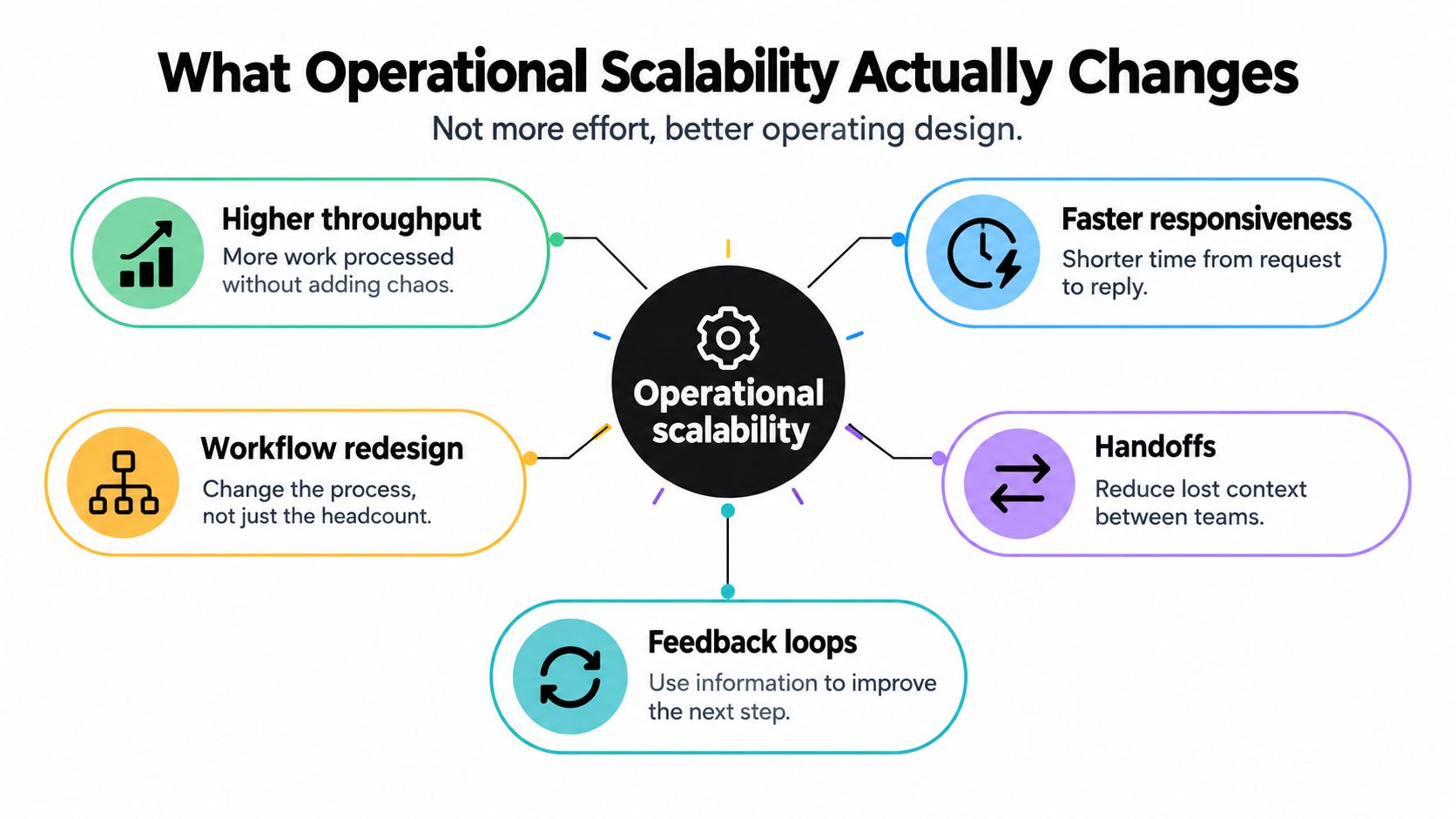
Operational scalability means you can process more work and respond appropriately without adding people, inboxes, and manual checks in direct proportion to volume. It doesn't mean every item gets automated. It means the workflow changes so human attention goes where judgment changes the outcome.
Think of the difference this way. Adding two agents to watch two new channels is growth in capacity. Redesigning intake so every channel enters one triage flow, with shared tags and owners, is scalability. The first approach multiplies the same manual work. The second removes repeated sorting from every shift.
A manufacturing analogy that clarifies the idea
Toyota's early history is useful here, not because factories and social queues are the same, but because both expose weak handoffs under volume. The Koromo Plant began operations in November 1938 with approximately 5,000 people and capacity for 2,000 vehicles per month, according to Toyota's history of its early production system. An early just-in-time initiative targeted an increase from 1,542 to 3,000 vehicles monthly. By the end of 1956, monthly production reached approximately 5,000 vehicles, more than triple the earlier baseline, as documented in that Toyota history.
The instructive detail isn't the vehicle count alone. Toyota later revised production planning from monthly schedules to 10-day schedules, and average order-to-delivery time fell from 50 days to 25 days. Shorter planning loops made the system both higher-throughput and more responsive. Work moved with fresher demand signals instead of waiting for a monthly reset.
Translate that into social operations. A weekly spreadsheet of unresolved mentions is your monthly schedule. A live triage flow that tags intent, urgency, and owner as items arrive is the shorter loop. You're not just replying sooner. You're learning sooner that billing complaints are clustering after a price change, or that a product bug is appearing first in Telegram before it reaches support tickets.
What changes in practice
First, standardized triage replaces individual sorting habits. Every item receives consistent labels for intent, urgency, language, and risk, whether it arrived on X, Instagram, TikTok, Discord, Telegram, WhatsApp, or a forum. Consistency makes queues comparable across channels.
Second, demand-linked routing sends work to the team that can resolve it. Billing goes to support or finance, outages go to engineering and support, reputation risk goes to comms, and threats go to trust and safety. Agents stop forwarding screenshots and hoping someone claims them.
Third, synchronized handoffs preserve context. The receiving team sees the original post, prior replies, tags, and customer history instead of starting from a pasted link. Fewer handoffs get lost, and fewer customers repeat themselves.
AI filters noise and drafts the rest. Humans approve, decide, and own the hard calls.
That line is the operating thesis. Automation handles clear spam, duplicates, and repeat low-risk questions. AI drafts replies in brand voice for routine cases a reviewer can approve quickly. Humans keep authority over money, safety, public statements, account actions, and anything ambiguous.
Operational scalability therefore spans care, community, comms, and insights. Care resolves the customer's issue. Community teams protect discussion quality. Comms owns public language when risk rises. Insights leaders see which intents, channels, and failure patterns are growing before executives ask why the queue missed its SLA.
Metrics Leaders Should Watch Beyond Speed
Speed matters, but speed alone tells you very little about whether scale is healthy. One-third of consumers expect replies to tags and direct messages within one hour, while two-thirds prefer a human response even when AI support may be faster, according to Emplifi's 2025 consumer and brand survey on social expectations. Those two findings pull in opposite directions. Customers want a fast first signal and a competent human where judgment matters.
That tension makes auto-closure an operating decision, not a product setting you raise until the dashboard looks efficient. If AI closes a sarcastic billing complaint because it contains the word "thanks," your auto-closure rate improves and your repeat-contact problem grows. The customer returns angrier, now in public.
Build a scorecard that can disagree with itself
A useful scorecard lets one metric challenge another. Throughput should mean cases moved to a correct owner or resolution, not items touched. Latency should measure time to first appropriate acknowledgement, because a generic bot reply to a fraud report isn't responsiveness. It's noise with a timestamp.
Track escalation accuracy separately. Did billing disputes reach finance or support, outage reports reach engineering, and threats reach trust and safety on the first route? Every wrong route adds a hidden queue inside the visible queue. The customer waits while teams pass the case internally.
Track repeat contacts and reopened cases by issue type and channel. A password question that reopens may signal a weak help article. A billing case that reopens may signal premature closure. A Discord safety case that reappears in a new thread may signal that the first action didn't address the community risk.
| Metric | What a healthy reading means | How it misleads alone |
|---|---|---|
| First acknowledgement time | Customers see a timely, appropriate first signal | A generic auto-reply can hit the target without owning the issue |
| Auto-closure rate | Clear spam and resolved low-risk repeats leave the queue | Misclassified complaints disappear, then return as repeat contacts |
| Escalation accuracy | Cases reach the right owner on the first route | Teams can over-escalate everything and overload specialists |
| Reopened cases | Resolutions stay resolved | Low reopen rates can hide customers who gave up |
| Reviewer fatigue | Reviewers can sustain careful judgment across a shift | It's hard to see in reply counts until errors rise |
| Negative outcomes by intent | Harm is visible where it actually occurs | Averages can bury failures in billing, safety, or one language |
Reviewer fatigue is a scale metric
Leaders often treat reviewer fatigue as a staffing complaint. It's an accuracy risk. If your model sends every uncertain item to the same two senior agents, they become the bottleneck and the quality control system at once. Their decisions slow down, then their error rate becomes your escalation error rate.
- Confidence-calibrated automation: Does AI act only where its confidence and the risk level justify action?
- Escalation accuracy: Did the first human owner have authority to resolve the case?
- Repeat contacts: Did closure end the customer's problem or only your ticket?
- Reopened cases: Which intents come back, and after what kind of reply?
- Negative outcomes: Where do complaints, public escalation, or abandonment concentrate?
The abandonment risk is not abstract. 70% of consumers may abandon a brand after two negative experiences, and 32% expect a response to a social media direct message within one hour, according to Emplifi findings reported on consumer abandonment after negative experiences. A fast wrong closure can count as one of those experiences.
So don't ask what percentage of tickets AI can handle. Ask what the human-in-the-loop threshold should be by intent, urgency, language, customer value, and reputational risk. A clear spam wave can close automatically. A duplicate charge should not. That distinction is where operational scalability becomes trustworthy.
How Routing Turns Noise Into Owned Work
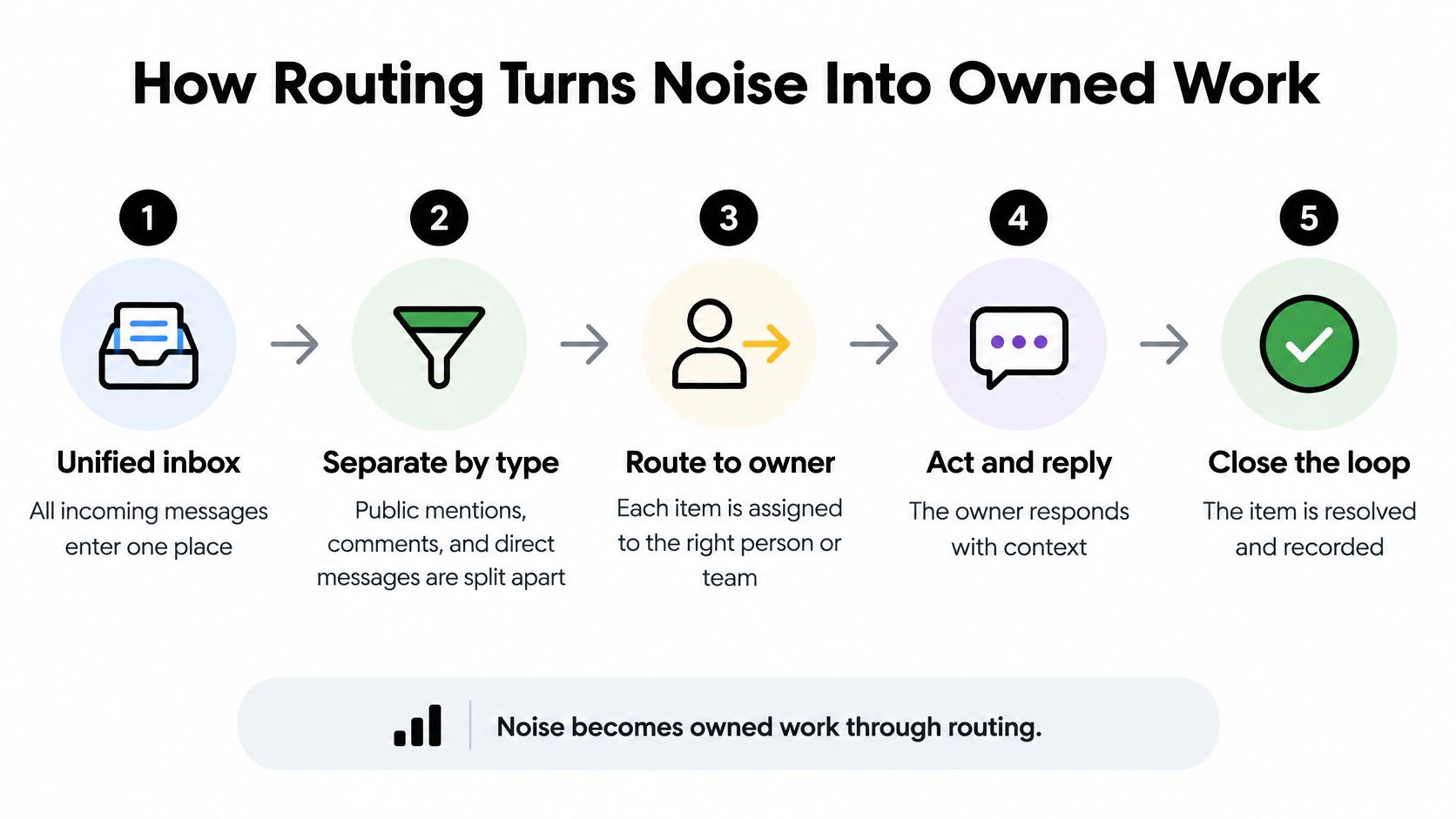
Routing is where an item stops being "something someone should check" and becomes owned work. Start with a unified inbox that separates public mentions, comments, and direct messages across X, Instagram, TikTok, Discord, Telegram, WhatsApp, and forums. Separation matters because a public complaint and a private account message need different first actions, even when they describe the same problem.
AI filters obvious noise first. Spam, duplicate posts, bot bait, and repeated scam copy shouldn't consume reviewer attention. What remains gets tagged for intent, urgency, language, and risk, so the next step is a decision rather than a fresh read from zero.
Follow one ambiguous word
Take a short Instagram comment: "Charged again, great." A keyword rule sees "charged" and maybe "great," then guesses. A context-aware system has more to work with, including the thread, prior posts, account signals where available, and whether similar complaints are spiking.
That one word can fork three ways. It may be a duplicate payment that belongs with support or finance and needs private account handling. It may be a sarcastic joke under a product announcement that needs no care case. It may be the first visible sign of unauthorized charges affecting multiple customers, which needs urgent escalation and pattern review.
- Detect: Capture the comment with its channel, thread, and public visibility intact.
- Tag: Label likely intent, urgency, sentiment, language, and confidence.
- Choose the path: Auto-close only if it's clearly noise or resolved, draft for review if it's routine but customer-facing, or escalate immediately if money, safety, or reputation risk is plausible.
- Assign an owner: Send billing to support or finance, product defects to product or engineering, PR risk to comms, and scams or threats to trust and safety.
- Record the decision: Keep the tag, route, draft, approver, and outcome attached to the case.
Public first, private when details require it
If the customer posted publicly, acknowledge publicly when that's appropriate. Then move payment details, account identifiers, and personal data into a private thread. Reversing that order creates two problems. Bystanders see silence, and the customer may share sensitive information in public while waiting.
Drafts should follow brand voice, but a draft isn't permission to send. A reviewer approves anything ambiguous, multilingual, emotionally charged, or tied to money and safety. For a routine store-hours question, approval can be quick. For "charged again," the reviewer checks whether the draft asks for private details safely and whether finance needs the case before any promise is made.
Routing test: If the receiving team must ask, "Why is this ours, and what happened before it reached us," the handoff hasn't scaled yet.
Feature requests need the same discipline. A DM saying "export still broken on Android" isn't just product feedback if the customer can't complete work today. Route the immediate problem to support, attach the product signal for engineering, and keep both actions linked. Otherwise product hears a vague request weeks later, and support never learns the workaround failed.
The repeatable pattern is simple to say and hard to fake. Detect, tag, choose an owner, draft or escalate, and record why. When that pattern holds across channels, volume becomes sortable work instead of competing tabs.
Platform Limits That Break Naive Automation
A workflow can classify messages correctly and still fail under load. Platforms impose technical ceilings on how often your systems can poll, post, sync, and update cases. Naive automation discovers those ceilings during the worst possible moment, usually a spam wave, launch surge, or outage.
Discord gives a concrete example. Its API limits apply per route and globally, exceeding a limit produces HTTP 429 responses, and bots can make up to 50 requests per second overall, according to Discord's developer documentation on rate limits. Discord also documents a separate limit of 10,000 requests per 10 minutes for some unauthenticated access patterns and warns developers not to hard-code limits because they can vary and change, as stated in that documentation.
How a surge turns into self-inflicted delay
Suppose a scam wave hits your Discord server while genuine users report they can't log in. An unthrottled system tries to fetch every new message, tag it, sync it to your CRM, post moderator actions, and update dashboards at full speed. It receives 429 responses, retries immediately, and burns more of the available budget. Legitimate login cases now wait behind retries for spam that should never have received equal priority.
That's the hidden scalability question. Can your orchestration layer decide which API calls matter most when it can't do everything at once? Fetching a possible safety report should outrank syncing a low-risk analytics tag. Posting a human-approved outage acknowledgement should outrank refreshing a dashboard tile.
- Queueing: Hold lower-priority writes and syncs until capacity returns.
- Backoff after 429 errors: Wait before retrying instead of hammering the same route.
- Route-aware throttling: Respect that limits differ by endpoint, not only by total volume.
- Priority lanes: Reserve capacity for safety, outage, and approved public replies.
- Human review for high-risk posts: Don't spend scarce posting capacity on unapproved language you'll need to retract.
Don't hard-code another platform's numbers into Discord logic, and don't invent limits for X, Instagram, WhatsApp, Telegram, or forums. The transferable lesson is architectural. No channel is an unlimited pipe, and every integration needs failure behavior you have designed in advance.
Questions to ask before a spike asks them for you
Ask what happens when tagging works but posting is throttled. Ask whether CRM sync can lag without blocking an agent's reply. Ask which actions pause automatically, which ones queue, and which ones alert a human because delay itself creates risk.
Other operational teams hit the same pattern when disconnected tools each try to act at full speed, which is why guidance on fixing enterprise advertising workflow gaps can be useful reading on coordination failures between systems. The channel differs, but the failure shape is familiar. Local automation succeeds, shared capacity gets exhausted, and the customer-facing work slows down.
A model demo proves classification. A surge test proves operational scalability.
Test with ugly inputs, not clean examples. Include duplicate scam posts, meme screenshots, multilingual slang, and a burst of genuine outage reports arriving at the same time. Then watch whether queues preserve priority, whether reviewers still see high-risk items first, and whether 429 handling delays background sync instead of customer acknowledgement. If the workflow only works at average volume, it doesn't scale.
Scaling Through Outages Spam and Crises
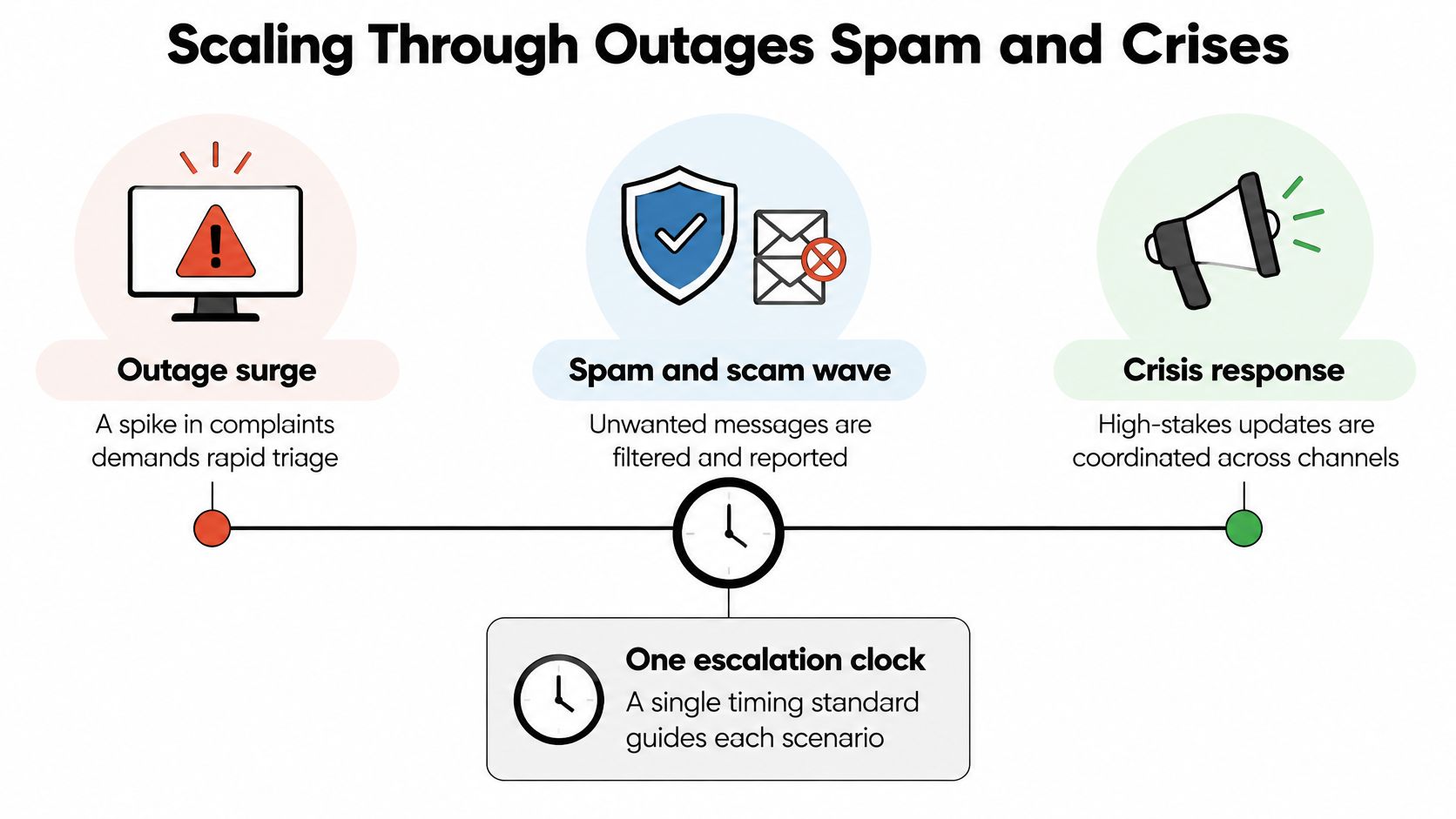
An outage surge, a scam wave, and a reputational mention can all spike your inbound count. They shouldn't follow the same automation rules. What they can share is one escalation clock, so leaders know which checkpoint is due and which team owns the next decision.
The Chartered Institute of Public Relations divides crisis response into an initial response during the first 1 to 2 hours, fact-finding during the next 2 to 4 hours, a public response within 4 to 24 hours, ongoing monitoring and adjustment over 24 to 72 hours, and resolution and recovery afterward, according to the CIPR crisis communications guide for social media. Use those windows as checkpoints, not as permission to wait. Detection and routing should happen immediately, long before the first public deadline.
Three incidents, three kinds of judgment
Start with an outage surge. Mentions jump across X and Discord, and DMs contain screenshots of the same error. AI can cluster the pattern, suppress duplicate triage, and route the incident to support and engineering. It shouldn't invent a cause or promise a fix time. Engineering confirms scope, support owns customer updates, and comms approves public language if the impact is broad.
Next, a spam and scam wave. Identical crypto pitches or fake support accounts flood comments and community channels. Where the pattern is clear, AI can filter, tag, and close at volume, while trust and safety reviews samples and edge cases. Here, high automation protects customers, provided genuine fraud reports from victims don't get swept into the same bucket as the scam posts themselves.
Then, a reputational mention. A customer alleges discriminatory treatment, a safety failure, or misleading pricing, and the post is gaining replies. AI can draft an acknowledgement and route the case instantly. A human in comms must decide what's verified, what needs investigation, and what the company can say publicly. A fast draft with the wrong facts creates a second incident.
Report checkpoints, not one average
Executives don't need a single average response time for an event that lasted three days. They need to know whether each checkpoint held.
- Initial response: Did affected customers receive an appropriate acknowledgement in the first window?
- Fact-finding: Did engineering, support, comms, or trust and safety confirm what was known and unknown?
- Public response: Did approved language go out with accurate scope and next steps?
- Monitoring and adjustment: Did volume, sentiment, and repeat reports change after the response?
- Resolution and recovery: Were reopened cases, refunds, fixes, or community repairs completed and recorded?
During a crisis, maximizing auto-closure is usually the wrong scale move. You're trying to preserve trust while facts are incomplete, not empty the queue.
That doesn't mean humans manually read every duplicate outage post. Cluster duplicates, link them to the parent incident, and keep representative cases open for updates. Close clear scam copies. Keep victim reports, vulnerable customers, journalists, regulators, and credible safety allegations in human-owned lanes.
After recovery, review the clock. Maybe acknowledgement held but fact-finding stalled because engineering had no named social liaison. Maybe the public response was accurate but monitoring missed a second wave on TikTok. Each failure points to a different fix. Collapsing them into "respond faster" teaches the team nothing.
Choosing an Operating Layer and Next Steps
You have three broad ways to scale, and they fail differently. Manual channel watching preserves human judgment until volume makes coverage impossible. Disconnected bots can clear narrow tasks while creating new gaps between channels, owners, and records. A governed operating layer connects intake, triage, routing, drafting, approval, and analytics, but only works if its permissions and escalation rules match your risk tolerance.
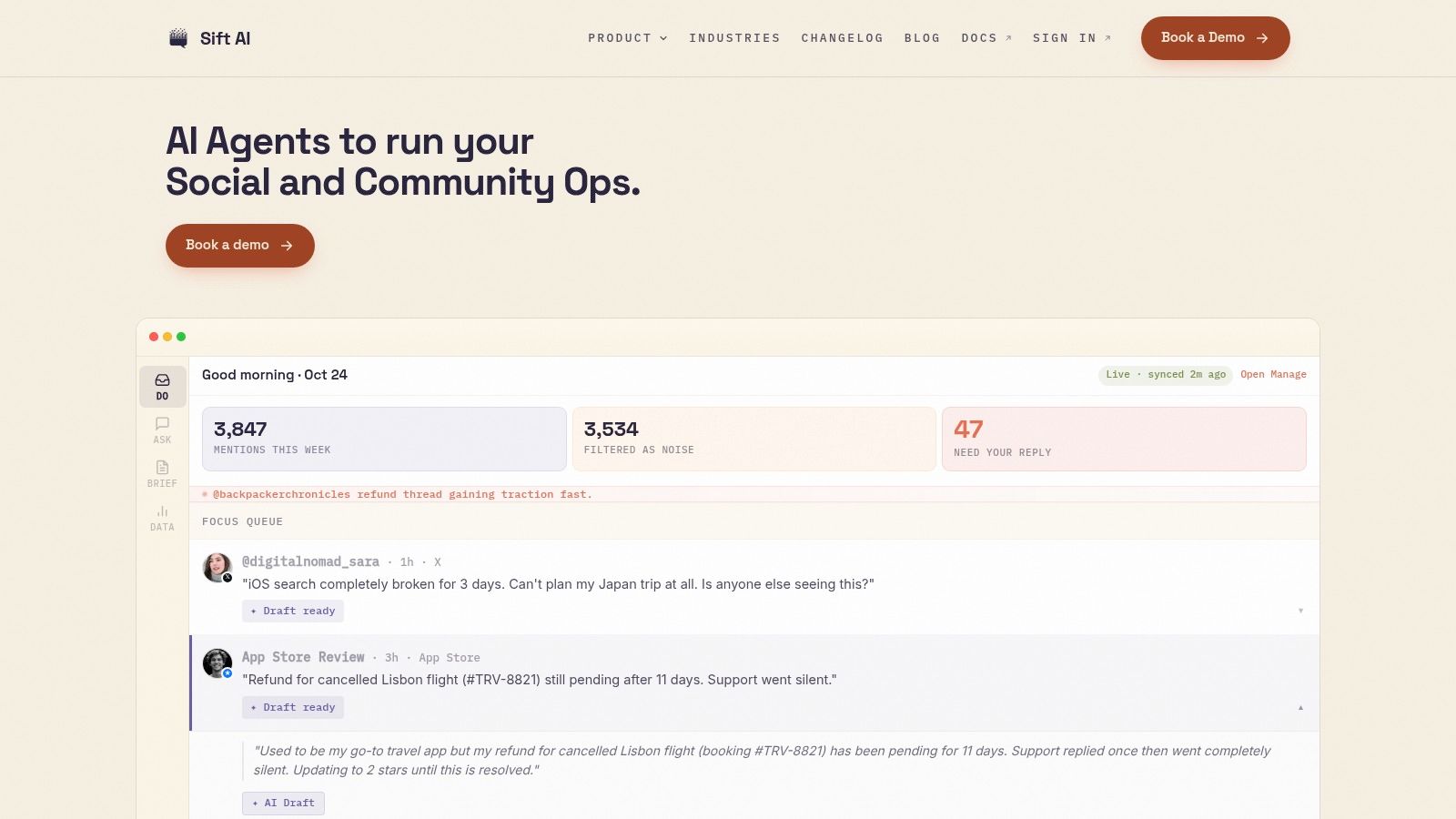
The screenshot below shows the kind of consolidated view to evaluate against your own queue, owners, and approval paths.
Governance is the capacity constraint
A 2025 global survey of 7,950 business and technical decision-makers across 30 countries found that 99% considered effective governance important for ethical agentic-AI deployment and 81% wanted technology partners to articulate a clear AI-led customer-experience vision, according to BARC and Endava research on innovating with agentic AI. In that survey, only 32% had agents in limited or full production, while 26% remained in pilot or experimentation. Adoption is moving, but governed production use is not yet the default.
Judge an operating layer by control questions, not agent count. Who can approve a public reply about billing, safety, or an outage? Which actions require a second reviewer? Can you roll back an automation rule, inspect an immutable audit trail, and see why an item was closed? Can reviewers test multilingual slang, sarcasm, images, and memes before those inputs reach customers?
- Role-based permissions: Separate who can draft, approve, post, close, and change rules.
- Approval thresholds: Tie review to intent, confidence, customer impact, and reputational risk.
- Audit trails and rollback: Reconstruct decisions and reverse bad automation quickly.
- CRM and data sync: Keep social cases connected to account and support history without blocking replies.
- Failure containment: Pause one workflow or channel without shutting down the whole operation.
Sift AI is one option to evaluate in that operating-layer category. It provides a unified inbox across social channels and communities, context-aware filtering, intent and urgency detection, routing to finance, engineering, comms, or trust and safety, drafted replies in brand voice, and analytics for noise filtered, auto-resolution, and proactive saves. Its enterprise controls include role-based permissions, SOC 2 and ISO readiness, and audits, with humans approving what matters.
The short walkthrough below gives you a concrete reference point for comparing that model with manual inboxes and disconnected point automation.
Start with one week of real work
Don't begin by raising an auto-closure target. Take one week of billing complaints, outage mentions, and scam waves from your actual channels. Sort each item into auto-close, draft for review, or immediate escalation, then name the human owner and approval threshold for the last two groups.
Review where your team disagrees. Those disagreements are your governance backlog. Maybe finance wants every refund mention escalated, while support can resolve duplicate charges under a clear policy. Maybe comms wants approval on outage language only after engineering confirms scope. Write those boundaries down before you automate around them.
Then test the split under surge conditions, including rate-limit behavior and reviewer load. If escalation accuracy falls, reopened cases rise, or senior reviewers become the queue, your threshold is wrong no matter how fast first replies look. Operational scalability holds when throughput, judgment, and accountability rise together.
Bring your billing complaints, outage mentions, scam waves, and community threads into one governed workflow where AI filters noise, tags intent, routes each case to its owner, and drafts replies for human approval. Visit Sift AI to see how your team can protect SLAs and brand voice without turning auto-closure into a race.