Brand Reputation Management: A Complete Enterprise Guide
A billing complaint is sitting in your public replies, a rumor is gaining replies in a forum thread you do not own, and a customer has just pasted an AI assistant answer that describes a breach from years ago as if it happened last week. None of these arrived as a press inquiry. All three are already shaping what the next buyer believes about you.
That's the daily reality for social ops and insights leaders now. You're accountable for SLAs, auto-closure, and what rolls up to executives, but the signals that create reputation risk don't respect team boundaries. They start in care, community, product, and search, then land on comms only after they've spread.
Table of Contents
- What Brand Reputation Management Covers Today
- How Monitoring and Intent Detection Catch Problems Early
- Routing Issues by Severity and Owner
- Managing Reviews and Ratings Across Locations
- Running a Crisis Playbook Step by Step
- A Worked Example From Billing Complaint to Outage
- Reputation KPIs That Prove the Work Pays Off
- Confirm Your First Channel and Owner This Week
What Brand Reputation Management Covers Today
Brand reputation management is a continuous loop, not a cleanup project after bad press. You detect what audiences say and ask about the brand across channels, you decide which team acts, and you prove the fix worked. If any part of that loop breaks, the public record fills the gap for you.
That definition matters because reputation now influences purchase decisions at the moment people discover a problem. In a fall 2024 survey of 2,000 U.S. consumers, 69% said brand reputation was important when making a purchase decision, according to Prodege research reported by Reputation.com. A slow reply, an unanswered review, or a wrong AI answer isn't just a communications miss. It's a reason for a prospect to choose someone else.
Why This No Longer Sits Only With PR
PR still owns public statements and media risk, but PR doesn't own the billing system, the outage, the refund queue, or the fake support account. Social care sees account problems first. Community managers see rumors form in Discord, Telegram, and forums. Product teams own the feature gap buried in DMs. Insights leaders see whether the same complaint keeps returning after a team says it's fixed.
Treating all of that as sentiment monitoring leaves you with a chart and no owner. A closed-loop operating system gives each signal a queue, a severity, and a person who can change the underlying condition. For smaller teams building the same habits with fewer people, Bragly's small business reputation playbook is a useful companion on review routines and local visibility, but enterprise teams still need the cross-functional routing below.
AI answers now carry reputation too. Research found that 27% of marketers said their brand had been inaccurately described or misrepresented in an AI-generated response, according to Fractl's AI statistics research. Publishing more positive posts won't correct a wrong source page that AI systems keep summarizing. You have to log the claim, trace where it came from, and fix the authoritative record.
The Seven Signals You Have to Own
| Signal | Where it appears | Owner | First action |
|---|---|---|---|
| Billing complaint in replies | X replies, Instagram comments | Social care with finance | Acknowledge publicly, move account details to DM |
| Outage surge | Mentions, Discord channels, forum threads | Engineering with social care lead | Tag the incident and group duplicates |
| PR risk in mentions | Mentions, press-linked posts | Communications | Alert the comms lead at once |
| Scam or impersonation wave | DMs, fake support accounts, payment links | Trust and safety | Preserve evidence and flag links |
| Feature request in DMs | Direct messages, community threads | Product | Tag and send to the product backlog |
| Multilingual slang or sarcasm | Replies on any channel | Care lead for human review | Hold the reply until a reviewer confirms intent |
| AI-generated misstatement about the brand | AI assistant answers, search results | Communications with legal and product | Log the claim and trace its source |
Read the table as an owner map, not a taxonomy exercise. A billing complaint needs care and finance because only finance can correct the charge. An outage needs engineering confirmation before care promises a time. A scam wave needs trust and safety because a polite support reply doesn't remove a phishing link. Sarcasm and slang need a human reviewer because intent detection can misread tone, especially across languages. An AI misstatement needs comms, legal, and product together because the correction may involve a help page, a policy fact, and a public clarification.
The frame for the rest of this guide is simple. Detect, route, and prove. Detect the signal early enough to act, route it to the team that can fix the cause, and prove with operating metrics that customers stopped experiencing the problem.
How Monitoring and Intent Detection Catch Problems Early
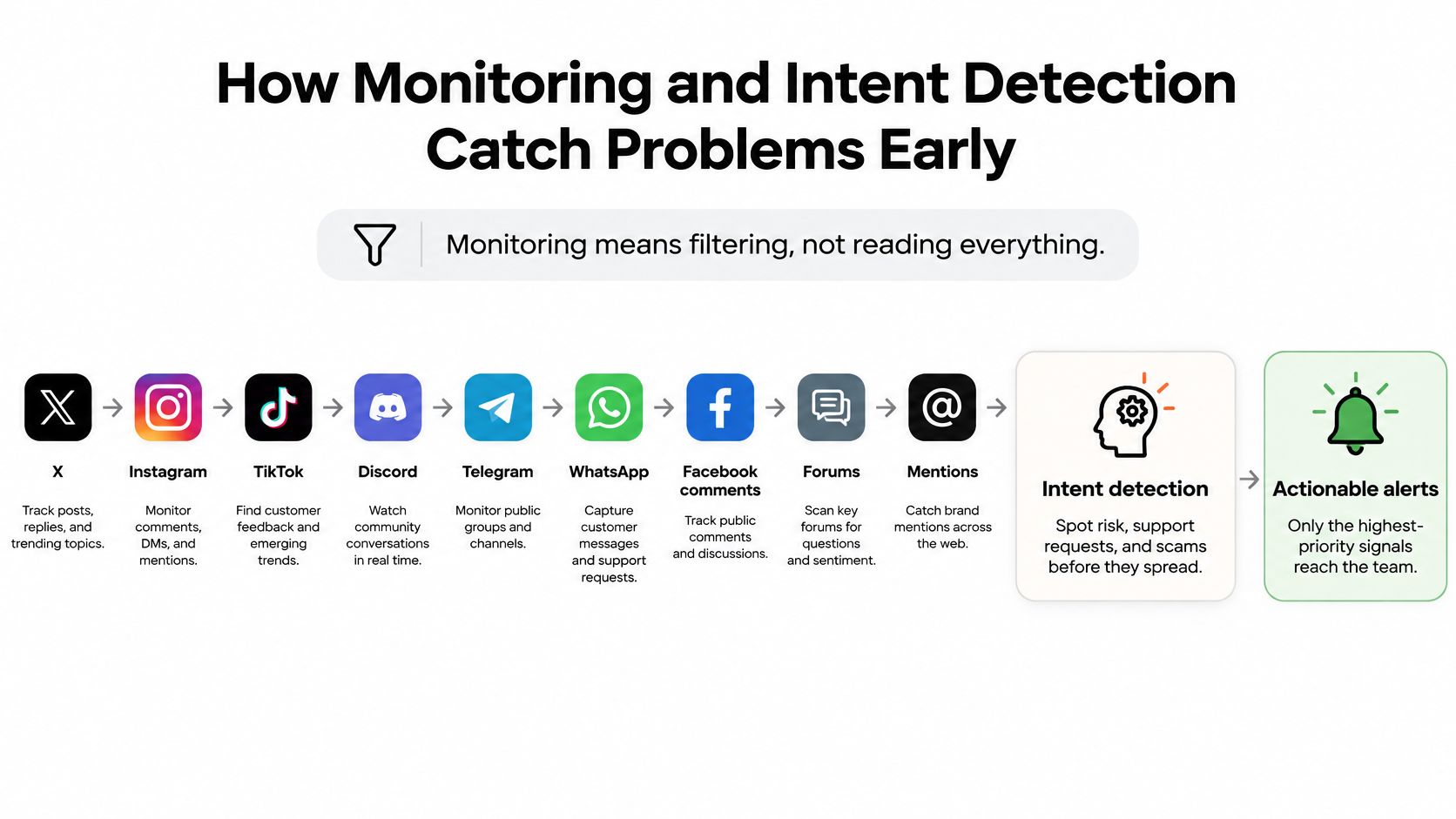
Monitoring means filtering, not reading everything. If your team tries to read every mention in native apps, reviewer fatigue sets in fast and the messages you miss are usually the ones with real support intent.
Volume is rising while coverage slips. Sprout Social reported that average daily incoming Instagram messages increased from 13 to 18 between 2023 and 2024, while the overall daily response rate for social messages and comments declined from 8% to 7%, according to Sprout Social's customer service statistics. That gap is the operational risk. A dashboard can show more conversations while fewer customers get help.
The flow below shows how channel coverage, intent detection, and prioritized alerts fit together before a human opens a queue.
Channels That Belong in One View
Cover X, Instagram, TikTok, Discord, Telegram, WhatsApp, Facebook comments, forums, and mentions in one unified inbox. Splitting them by platform creates blind spots because the same outage often appears first as a Discord thread, then as X replies, then as app store anger. One inbox lets you group those duplicates around a single incident instead of counting them as unrelated complaints.
Intent tagging is what makes that volume usable. At minimum, tag for complaint, billing, outage, feature request, scam, PR risk, praise, and spam. Add severity and language where you can. A tag should answer two questions instantly. What does this person need, and what happens if nobody acts today?
Keyword filters alone won't do that work. Say a customer replies, "great, another update," after a failed release. A keyword system can score "great" as praise and auto-close it. A context-aware system, checked by a human on ambiguous cases, is more likely to flag frustration because the thread, timing, and surrounding outage posts change the meaning.
Practical rule: If a message could be sarcasm, a refund demand, or a safety issue depending on context, don't auto-close it. Hold it for human review.
The Six Step Triage Flow
- Pull everything into one inbox. Messages, mentions, comments, and DMs need one queue so duplicates and cross-channel surges stay visible.
- Filter spam and duplicates. Noise removal protects reviewer attention for customers who need an answer.
- Tag intent and severity. Billing, outage, scam, and PR risk can't wait in the same line as routine praise.
- Group repeat issues. Fifty posts about one payment failure should become one incident view with fifty affected customers, not fifty disconnected tickets.
- Route each item to its owner. Finance, engineering, product, comms, and trust and safety each receive work they can resolve.
- Hold sensitive cases for humans. Refunds, legal questions, crisis language, and ambiguous multilingual slang need approval before a reply goes out.
AI can filter spam, detect likely support intent, group repeated complaints, and draft replies in brand voice. Humans should approve anything that commits money, admits fault, interprets policy, or speaks for the company during an incident.
Prove coverage with measures that show work is reaching people, not just arriving. Track noise-filtered share to see how much load automation removes, time to first tag to see how quickly risk becomes visible, and the percentage of conversations requiring human review to staff the queue effectively. If human review keeps rising, your tags or thresholds need work. If it falls while complaints rise, auto-closure is probably hiding demand.
Routing Issues by Severity and Owner
Routing fails when every urgent-looking post gets treated as urgent and every quiet complaint waits until it becomes public. A severity ladder prevents both errors. Decide severity from the monitoring tags plus volume, velocity, and who is involved.
| Severity | Typical example | Route to | First response target |
|---|---|---|---|
| Low | Single question or praise post | Social care queue | Within 24 hours |
| Medium | Repeated billing complaint in replies | Finance via tagged queue, social care acknowledges | Public acknowledgement within 24 hours, then private resolution |
| High | Outage surge across several channels | Engineering with social care lead | Holding reply in the same shift |
| Critical | Viral PR risk or a named executive | Communications and legal | Comms lead alerted at once, one approved statement |
| Security | Phishing link or fake support account | Trust and safety | Evidence preserved and takedown requested |
Routing sends work to a queue, not to a person's memory. The owner in this map receives the case even when that owner is a shared inbox for finance or trust and safety. That's deliberate. Shifts change, people take leave, and a reputation case can't depend on one employee seeing a Slack message.
The Two Stage Rule for Public Complaints
Public complaints need a visible start and a private resolution. In a September 2025 survey of 2,270 social users in the United States, United Kingdom, and Australia, 51% of people who contacted a company publicly through an @-mention or comment expected an initial response in that same public setting before continuing privately through direct messages, while only 32% expected the entire response to remain in the public setting, according to the Sprout Social Q4 2025 Pulse Survey.
So I would acknowledge publicly first, in plain language, without asking for account data in the thread. Then move billing information, identity verification, and order details into a DM or secure support workflow. The public reply shows ownership to everyone watching. The private channel protects the customer and gives your team room to verify facts.
Don't auto-close the public thread just because a private ticket exists. To anyone reading later, silence looks like neglect. The thread should show that you responded, and the case should stay open internally until the customer confirms resolution or the owner verifies the fix.
Escalation Triggers That Override the Queue
Some signals shouldn't wait for normal sorting, even if volume is low:
- Legal threat: A customer threatens legal action, a regulator, or formal dispute. Route to comms and legal before care drafts anything beyond acknowledgement.
- Verified media engagement: A journalist or verified media account amplifies the complaint. Comms needs the full thread and the operational facts at once.
- Velocity spike: Post count on one issue doubles within a single shift. Treat it as a possible incident until engineering or product rules one out.
- Refund above the approved limit: Finance sets the ceiling in advance. Care can acknowledge, but a human with authority approves the money.
Humans approve refunds, credits, policy exceptions, and every public statement. Automation can prepare the case, group duplicates, and draft the acknowledgement. It can't decide what the company is willing to concede.
The 24-hour first-response target in the table is an SLA for acknowledgement, not a promise that every billing dispute or technical failure will be fully resolved in a day. Keeping those two clocks separate protects customers and teams. The customer hears from you quickly. The owner still has a tracked path to closure.
Managing Reviews and Ratings Across Locations
Reviews on Google Business Profile, Yelp, TripAdvisor, app stores, and forums aren't a separate reputation program. For multi-location brands, they belong in the same queue as social messages because customers describe the same failures in both places, often with more detail in a review.
Pull every review into one queue, then tag each by location, product, issue type, and star rating. That segmentation keeps one struggling branch from being averaged away by stronger locations. It also lets product and operations see whether complaints cluster around parking, wait times, app login, pricing, or a specific manager's shift.
Route tagged reviews with the same owner logic you use for social. Finance takes pricing disputes. Engineering takes app failures. Social care takes account-specific questions and invites the reviewer into a private workflow when personal data is needed.
The financial case for doing this well is concrete. Harvard Business School research using Yelp ratings and Washington State restaurant revenue data found that a one-star increase in average Yelp rating produced approximately a 5 to 9% revenue increase, with the strongest effects among independent restaurants rather than chains, according to Harvard Business School's faculty research summary. You can't reply your way to that lift if the underlying service problem stays in place. Reviews move revenue because they teach future customers what current customers experienced.
Draft replies in brand voice, but require human approval for any reply that promises a refund, a fix, or a policy change. A reply to a negative review should create an internal commitment with an owner and a date, not just a polite paragraph. Publicly promising a correction that operations never delivers creates a credibility gap customers can verify on their next visit.
Automation can carry routine thanks for positive reviews, with light personalization from the review text. A person should write any reply that concedes a failure, disputes a fact, or involves health, safety, discrimination, or money. When you need more first-party feedback at the point of service, you can collect guest reviews with HolaQR as one practical way to prompt a Google review while the experience is still fresh. The request only helps if the operation behind it is sound.
Running a Crisis Playbook Step by Step
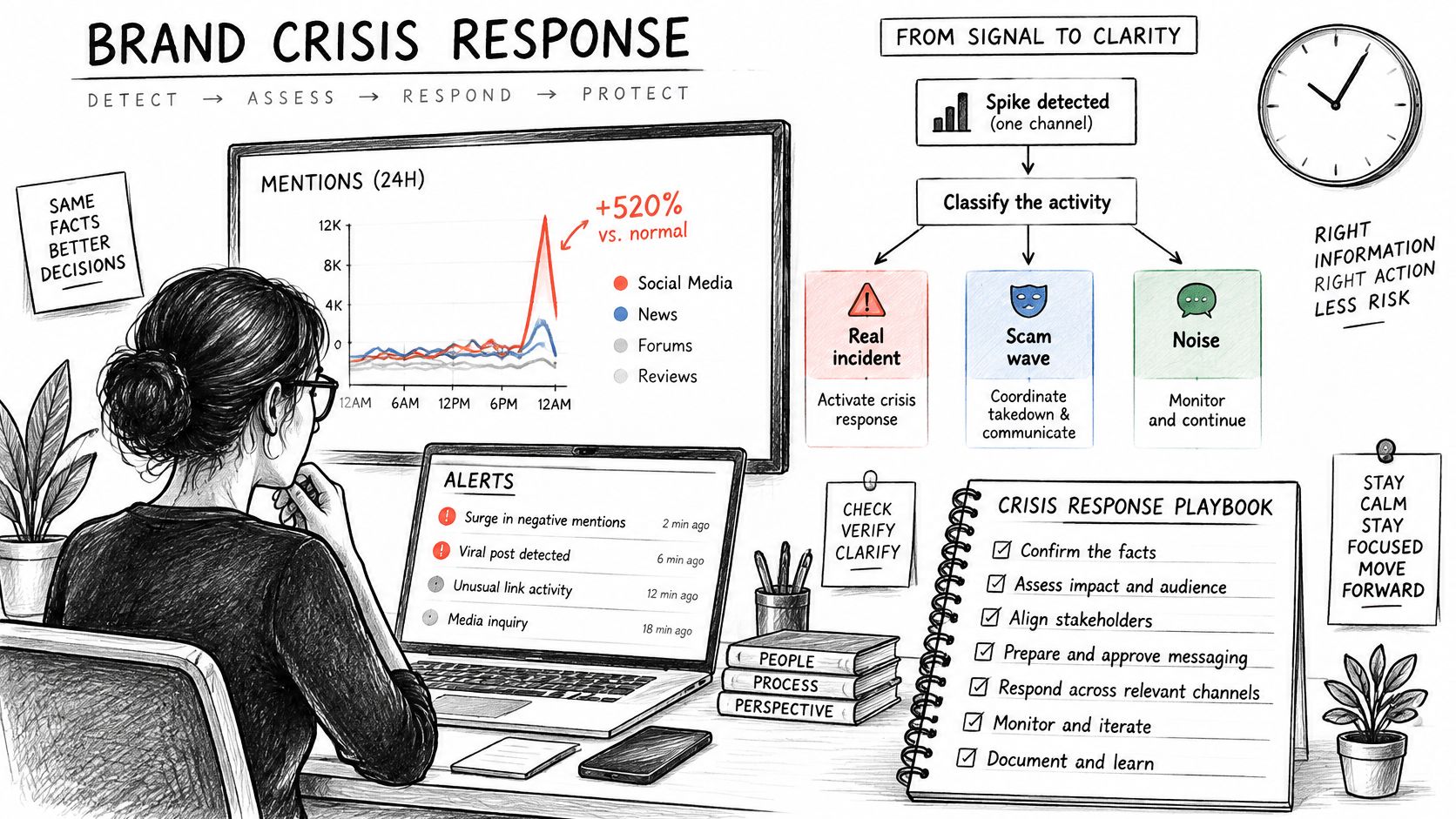
A crisis starts operationally before it starts publicly. The trigger is a spike well above normal volume for a channel, sharing one cause, or a single high-risk signal such as a scam link spreading under your brand name.
The desk-level workflow below is the point. Alerts, owners, evidence, and approved language have to come together in one place while volume is still rising.
Nine Steps From Signal to Verified Fix
- Classify the signal. Use monitoring tags to separate a real incident, a scam wave, and noise. Misclassification wastes the first hour, so confirm whether customers are reporting your failure or someone impersonating you.
- Preserve evidence for scams. Save usernames, links, screenshots, and timestamps, then route to trust and safety. The Federal Trade Commission reported that consumers lost $1.9 billion to scams originating on social media in 2024, and 70% of people who reported being contacted through social media said they lost money, according to the FTC's top scams of 2024 alert. Fake support accounts are therefore a security case, not ordinary care volume.
- Name two owners. Assign one incident owner for operational facts and one communications lead for public language. Shared ownership without a named decision maker produces conflicting replies.
- Draft holding language. Prepare a holding statement and approved answers for the questions customers are already asking. Humans sign off before anything publishes, and care teams don't improvise cause, scope, or restoration times.
- Acknowledge on affected channels. Post where customers are reporting the problem, not only where your team prefers to post. Move account-specific details into DMs while keeping the public status visible.
- Track at a fixed interval. Review volume, open cases, new intents, and sentiment on a set cadence through the peak. A falling post count with rising repeat complaints means the incident is changing shape, not ending.
- Log every promised action. Record the commitment, owner, and date in the case system. A public promise that doesn't change operations becomes the next trust problem.
- Verify before closing. Confirm the refund posted, the fix shipped, or the takedown completed. Then publish the outcome in the same channels where you acknowledged the problem.
- Run the post-incident review. Cover root cause, repeat complaints, detection time, handoff delays, and playbook updates. Assign each correction before the review meeting ends.
This walkthrough shows the response sequence in a format you can use for team training and tabletop drills.
Disclosure needs a specific rule during incidents, not a vague preference for transparency. Multinational research found that 86% of consumers consider disclosure of AI-generated content important, according to PRWeek's report on AI and trust. If automation helped sort messages or draft replies, your statements and help pages should make human accountability clear, explain how customers reached a person, and show how errors get corrected.
Don't close a crisis because the timeline got quieter. Close it when the cause is fixed, affected customers have a path to resolution, and every public commitment has an owner who verified completion.
The teams that handle crises well aren't faster at writing statements. They're faster at separating signal types, getting operational truth, and stopping care agents from freelancing under pressure. Speed without classification just publishes uncertainty sooner.
A Worked Example From Billing Complaint to Outage
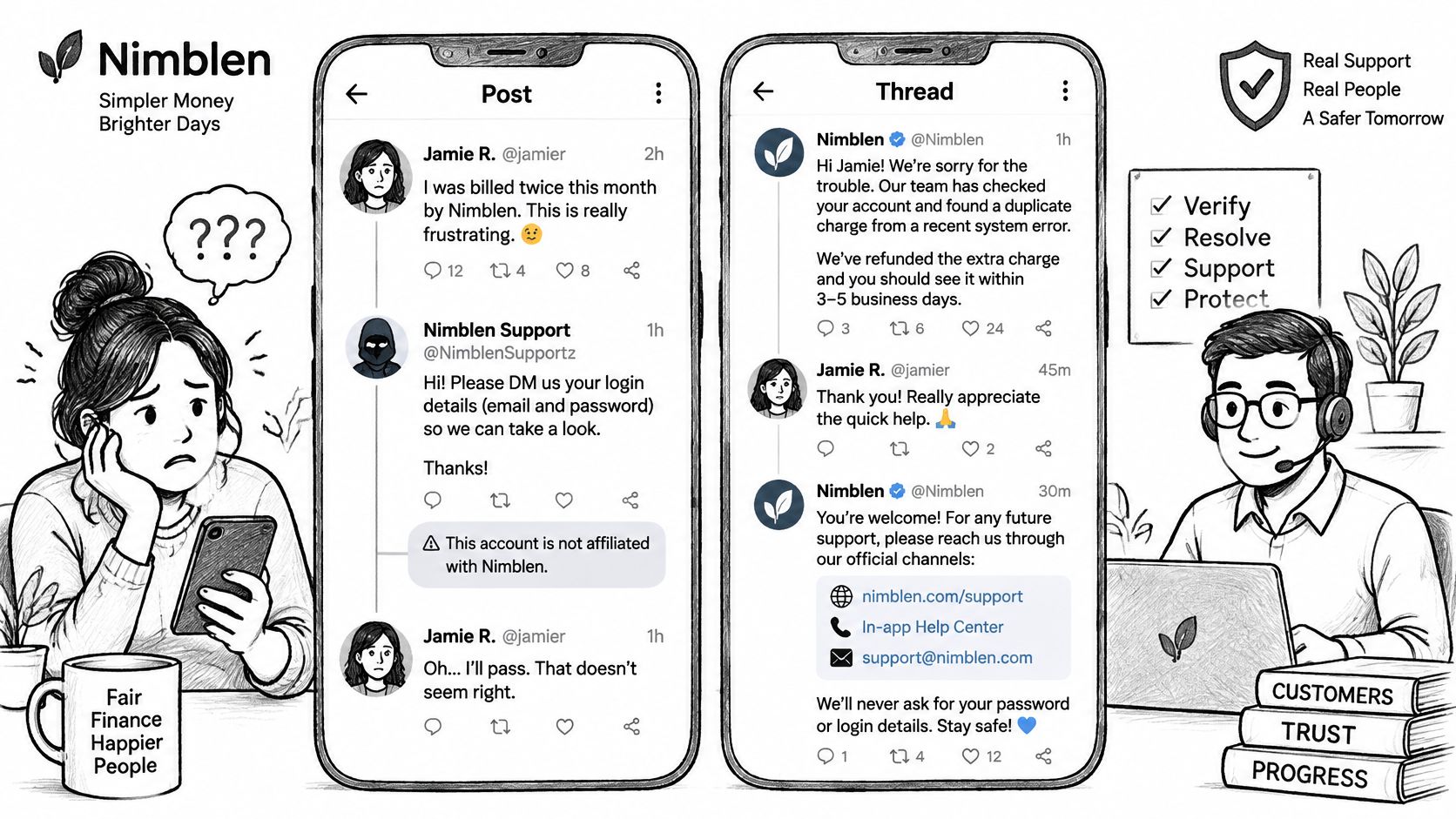
Say a hypothetical fintech brand changes its pricing on a Tuesday morning. By lunch, replies fill with billing complaints. A fake support account starts messaging users for login details, and that afternoon a payment outage begins. Three reputation problems now share one timeline, but they need three different owners.
The comparison below is useful in training because customers often can't tell a scam interaction from a legitimate support handoff at a glance.
Hour Zero to the First Handoff
In hour zero, volume jumps and tags separate three patterns. Billing posts mention the new charge. Scam reports include a suspicious handle and a login link. Outage posts mention failed payments across X, Instagram, and Discord. The system filters spam and duplicates, groups repeat payment failures, and holds sarcastic or multilingual replies for review instead of guessing at intent.
Social care acknowledges billing complaints publicly and moves account details into DMs. The acknowledgement doesn't promise a reversal. It confirms the team is checking the charge and gives the customer a private route that doesn't expose account data. Finance receives the tagged queue with the plan type and charge date attached.
Trust and safety receives the scam wave with usernames, screenshots, links, and timestamps preserved. Care posts a warning from the verified account telling customers not to share login details and naming the only official support channels. Nobody replies to the fake account from the brand handle in a way that boosts its visibility.
The Afternoon Decision Points
Engineering confirms the payment outage and becomes incident owner for facts. The social care lead posts a holding reply in the affected channels, stating that payments are failing for some customers and that the team is investigating. Communications approves one statement that names the outage without speculating on cause or restoration time.
That restraint matters. A specific recovery time may calm the thread for ten minutes, then damage trust for weeks if engineering misses it. Customers get updates at a fixed interval instead, even when the update is that the investigation continues and no customer action is required.
After service recovers, the team checks repeat complaints by tag. Billing cases that reopen go back to finance with the original thread attached. The team verifies that the promised refund batch completed, then publishes the fix and the refund timing in the same channels where complaints appeared.
Monitoring was the smoke detector. Routing assigned the right crew. The post-incident review acted as the building inspection, checking why pricing confusion, impersonation, and a payment failure converged and which detection rule needs to change.
Software prepared the triage, grouping, drafts, and evidence bundle. People decided whether refunds were owed, what the public statement could claim, when the outage was over, and whether the pricing page itself created the confusion. That division is the operating model working as intended.
Reputation KPIs That Prove the Work Pays Off
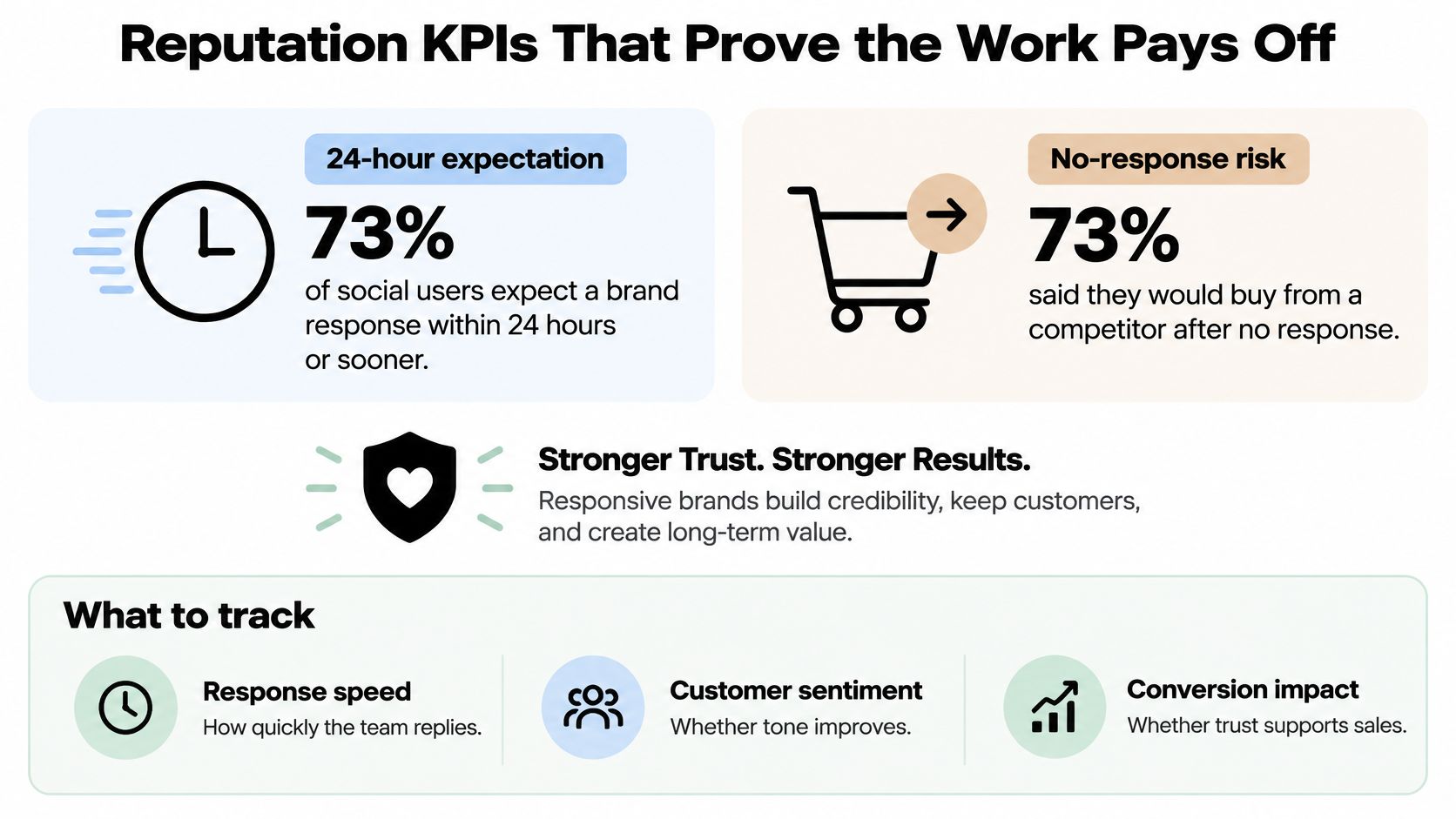
A reply can arrive within the expected window and still leave the customer waiting for a fix. Track response time and resolution separately: one measures acknowledgement, the other measures whether the refund, outage fix, or policy review reached an outcome.
The 2025 Sprout Social Index found that 73% of social users expect a brand response within 24 hours or sooner, and the same proportion said they would buy from a competitor if a brand failed to respond on social. Treat first response time as a revenue-protection measure, then pair it with metrics that show whether the underlying issue was resolved.
The KPI Set Execs Should See
| KPI | Definition | Target | What it reveals |
|---|---|---|---|
| First response time | Time from message to first reply | Under 24 hours | Acknowledgement speed against customer expectation |
| Auto-closure rate | Share of conversations closed without a human touch | Set per queue, track the trend | How much routine load automation carries |
| Repeat-complaint rate | Share of resolved cases that return with the same complaint within the agreed window | Falling quarter over quarter | Whether fixes actually stick |
| Public commitments fulfilled | Promised actions verified as complete | Every tracked commitment closed | Whether public statements match operations |
| Rating movement after remediation | Star or sentiment change after a fix, by segment | Direction and size against baseline | Whether the fix changed customer perception |
| Escalation rate | Share of conversations routed to an owner | Trend against team capacity | Whether routing rules are working |
Interpret the measures together. A rising auto-closure rate is useful only if repeat complaints do not rise with it. Fast acknowledgement does not prove that a commitment was fulfilled. During an outage, a higher escalation rate may reflect sound routing; during a normal week, it may point to broken tags or unclear ownership. Compare results by queue and incident before changing staffing or automation rules.
Review replies deserve a separate measure. Research links faster, substantive replies to reviews with higher TripAdvisor ratings, particularly for negative reviews. Track replies to negative reviews separately from routine positive ones, and compare rating movement after the promised remediation, not after the reply alone.
Add an AI Answer Audit
Record how often AI assistants misstate the brand, what claim is wrong, and which source page appears to feed the answer. Classify each problem as an outdated fact, a missing remediation record, or a harmful invention. Track corrections to authoritative pages, then recheck whether the answer changes. Automation can flag a mismatch; a person must decide whether the source is accurate and what the correction should say.
A single sentiment score can hide damage concentrated in one location, product, language, or customer segment. Segment results by product, location, issue type, and customer value. Where data allows, connect those patterns to conversion, retention, bookings, or support contact volume.
Give every KPI a named owner with authority to change the process behind it. That may mean adjusting staffing, routing rules, product behavior, or source content. If no owner can act on a measure, it is reporting decoration.
Confirm Your First Channel and Owner This Week
Choose one channel with a clear complaint pattern and make its ownership explicit. A shared inbox can work, but each issue type still needs a named destination: billing, outages, scams, PR risks, feature requests, ambiguous slang, and AI misstatements. Any category without an owner is a handoff gap to fix first.
Set two weekly measures: first-response time and a remediation measure such as repeat-complaint rate. The response measure shows whether customers receive an acknowledgement; the repeat rate indicates whether the underlying issue is still reaching customers.
Then run a tabletop drill using a scam wave during a billing surge. Have each team work through the handoffs using its real queues, templates, and approval paths. Record missing tags, failed handoffs, and decisions delayed by unclear authority. Fix the first failure before running the drill again.
For teams handling several social channels, Sift AI brings posts from X, Instagram, WhatsApp, Telegram, Discord, Facebook, and forums into one command center. It detects intent, routes issues to finance, engineering, and communications, and drafts replies for teams to use. Automation can prepare and prioritize the work; accountable teams still own the outcomes.
Orchestration, not replacement.
Test the playbook during an outage, pricing change, or impersonation wave. The signal should reach the right owner within the shift, and the team should verify the fix publicly. A sentiment chart alone does not close the loop.
Bring replies, mentions, DMs, reviews, and community threads into one operating view with Sift AI, where intent tags, routing, drafted responses, and SLA reporting support the detect, route, and prove loop. Sift AI helps teams reduce manual triage and coordinate social care across channels.